
Why most SMEs drift without a strategy – and how to change it.
Strategy is one of the key concepts in all my communication because it forms the absolute foundation for any lasting change I encourage Polish SMEs to pursue. Whether we are talking about sales growth, international expansion, brand building, or business model transformation – in each of these areas, strategy is not an addition but the starting point.
Strategic action has been widely discussed in management, sales, and internationalization literature. The differences between approaches mainly concern the level of strategy, its scope, and the way decisions are organized. Some publications focus on corporate strategy, others on competitive strategy, still others on internationalization or resource-based advantage. There are dozens of classifications, models, and schools of thought – and new ones keep emerging, which is a natural result of a changing world.
From a practitioner’s perspective, I propose an approach that is universal and can realistically be implemented in SMEs. The goal of this text is not to classify strategies but to understand their essence: what strategy is, what it includes, how it works, and how to manage it. Without this, any discussion of “strategy implementation” remains abstract.
According to available data, fewer than 30% of SMEs in Poland have ever worked strategically, and only about 10% have successfully implemented a strategy in practice. This means that the vast majority of companies operate reactively and randomly – also in international activities. My mission is to change this.
Why strategy provides an advantage – even before it takes effect.
One of the most accurate explanations of the purpose of strategy I found in Richard P. Rumelt’s book Good Strategy, Bad Strategy. The author notes that the first and most natural advantage of a good strategy is that most organizations… simply do not have one.
A good strategy is coherent; it coordinates actions, principles, and resources in a way that enables the achievement of a key objective. Meanwhile, most organizations operate based on many inconsistent initiatives that only simulate progress. Instead of a plan, they have a slogan: “spend more and try harder.” That is not strategy.
My approach is largely based on the classic works of Johnson, Scholes, and Whittington (Exploring Corporate Strategy) and on Polish studies (Podstawy strategii, PWE), complemented by more than fifteen years of practical experience in sales and export.
What strategy really is?
Strategy can be defined as a plan of actions that sets the long-term direction and scope of an organization’s activities, which – through an appropriate configuration of resources and competencies – allows achieving competitive advantage in a changing environment, while also meeting stakeholder expectations.
Key elements of this definition are often overlooked in practice. Strategy always concerns a long-term horizon – strategic change is a marathon, not a sprint. It requires decisions about what kind of company we want to be in a few years, which goals are truly important, and what resources we are ready to commit. It also requires cooperation between organizational units – often against their short-term interests.
Strategy also defines the scope of activity. Dispersal, diluting the offer, and lack of focus are among the most common reasons SMEs lose competitiveness. Not every opportunity is a chance, and not every sales increase means an increase in company value.
An integral element of strategy is building competitive advantage, without which margins inevitably shrink over time. The pace of change in the business environment is growing exponentially. In the cosmetics industry, we see this with the expansion of Korean brands, and soon Chinese brands. In Europe, the automotive sector faces price, technology, and design pressure from Asian manufacturers. Platforms like Temu or AliExpress show how quickly the competitive structure can change.
Strategy also means continuously monitoring the environment and adjusting market positioning – whether by finding a niche (for smaller companies), or through acquisitions, setting up subsidiaries, and optimizing supply chains (in larger organizations).
Finally, strategy must be grounded in the organization’s resources, competencies, and values. A strong brand, technology, team, clearly defined mission – all of these are sources of advantage if consciously used.
The cost of no strategy – two market case studies:
Where can acting without a clear strategy lead us?
For more than a decade, I have observed the professional cosmetics market in Poland. Several years ago, it was dominated by a few strong domestic brands with limited foreign presence. The professional market differs significantly from retail: it is based on channel exclusivity, specialization, and B2B relationships.
In pursuit of volume, many Polish brands decided to enter the retail channel. Professional products became widely available, prices started to fall, and the salon channel gradually lost motivation to cooperate. The effect? Distributors and salons began replacing Polish brands with foreign ones, available only through professional channels. Today, trade shows are dominated by brands from Germany, Italy, and Spain.
A similar mechanism I observed in a premium leather goods producer who decided to sell in discount stores. Short-term sales success led to a permanent shift in brand perception into the mass-market segment. The brand got stuck between segments, losing its ability to generate price premiums.
Strategic advantage built over years – Korea and China.
For contrast, it is worth looking at two model examples of long-term strategy. First, Korean cosmetics – the result of coordinated actions by the government, manufacturers, and social media. Based on cultural resources, technology, and precise recognition of Generation Z needs, they used the market moment almost textbook-style. South Korea became the world’s second-largest cosmetics exporter.
The second example is China and its strategic approach to batteries and critical raw materials. Controlling 60–70% of global extraction and processing of rare metals resulted in technological and production advantage, which today redefines the global automotive industry. Importantly, this process perfectly aligns with European electrification and environmental policies.
Strategic management – decisions, people, and consistency.
Strategy does not exist without people. Managers make decisions that either translate into strategy implementation or leave it in the drawer. One of the biggest threats for organizations is when management and owners focus solely on operational activities. Daily “firefighting” gives a sense of control but does not build the company’s long-term future.
It often happens that managers with strong operational skills are assigned strategic tasks. This can be a serious mistake. A person focused on operations risks not achieving daily goals efficiently and may experience frustration and lack of focus while trying to think strategically without the proper tools or experience.
The effect? Strategic goals remain unfulfilled, and operational performance may be disturbed. In the long term, this approach can seriously threaten the organization’s health – both in daily efficiency and in building lasting competitive advantage.
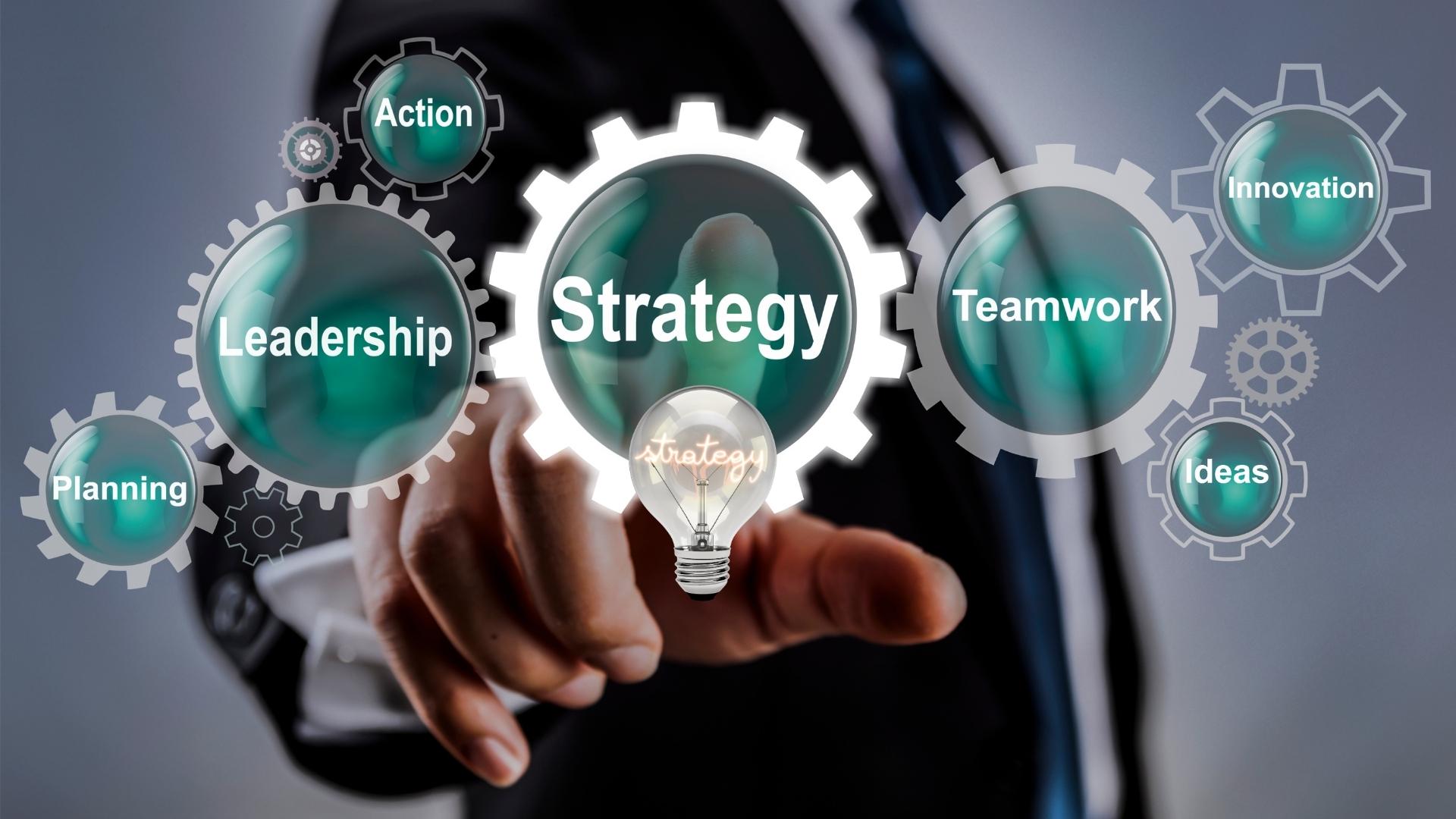
Thus, one of the key competencies of a leader is the ability to maintain a “helicopter view” – seeing beyond current problems and evaluating decisions in the context of the overarching goal. Strategic management includes three inseparable elements: understanding the organization’s strategic position, making choices, and implementing strategy. These elements influence each other and require continuous adjustment.
Strategy in practice – a real-life example.
Finally, it is worth seeing strategy in action through a concrete example. Imagine someone whose mission is to be healthy and athletic. This is their fundamental goal – a way of life that gives meaning to daily choices. Their vision is to complete an Ironman within a specific time – an ambitious, measurable goal requiring preparation and consistency.
How do they prepare? They need resources (time, proper diet, coach, equipment), capabilities (endurance, strength, swimming, cycling, running technique), and an action plan – a schedule of workouts, recovery cycles, and progress tracking. Daily decisions – whether and how to train, what to eat, when to rest – are made in the context of the vision and mission. Each small choice either brings them closer or farther from the goal.
The same mechanism applies in business. Strategy is not a document or a set of general guidelines – it is a conscious process of decision-making over time, based on coherence, consistency, and long-term thinking. In a company, every project, investment, and operational decision should be assessed through the lens of the organization’s mission and vision: does it bring us closer to the goal or just consume resources?
Just as an athlete monitors progress and adjusts their training plan, managers monitor strategy implementation and make corrections where actions diverge from the intended path. Strategy in business, like in sports, is not a set of rules on paper but a practical map of decisions that enables reaching an ambitious goal consciously and systematically.
In future publications, I will develop each element of this process further.
#Marketing #Digitalization #Ecommerce #Strategy #Sales

I’m an export advisor, strategist, and practitioner – with over 17 years of experience in developing international sales in the cosmetics and FMCG sectors.
I’ve successfully led the expansion of brands like Tymbark, Kubuś, Lubella, and Bielenda, building their presence in foreign markets. I’ve managed large teams, implemented innovative export processes, and co-created strategies that directly translated into growth.